What actually works in AI team training, and what does not
Companies are spending real money to get their teams up to speed on AI. Most of that spend is wasted, and the reason is consistent enough to call it a pattern.
This is a short field report from running these sessions and looking at what teams retain weeks later.
The finding in one line
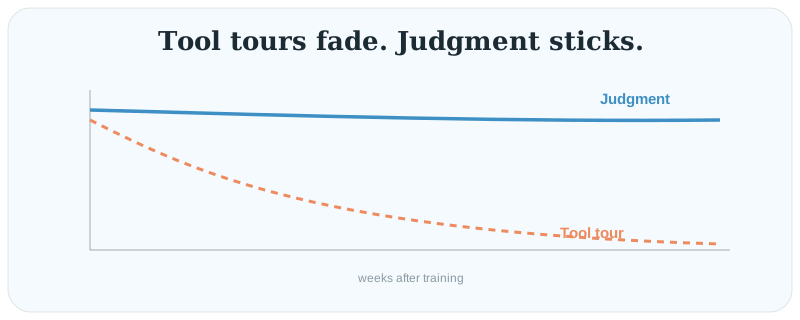
Training built around tools fades fast. Training built around judgment lasts. When you teach features, people forget them the moment the interface changes.1 When you teach how to think about the work, it survives the next model release.
What does not work
- The tool tour. A walkthrough of every button and feature. People nod, take notes, and remember almost none of it a week later.
- Generic prompt packs. A list of prompts disconnected from anyone's real job. They get copied once and never opened again.
- One big lecture. A two-hour talk with no hands-on time. Attention falls off a cliff, and nothing transfers to Monday.
- Fear framing. Sessions built around the threat of AI. People leave anxious, not capable.
What does work
- Real work, real examples. Build the session from the team's actual tasks. Transfer happens because the practice is the job.
- Judgment over features. Teach where AI helps, where it fails, and how to check it. That mental model outlives any specific product.
- Hands-on time in the room. People try it, hit a wall, and get unstuck live. The unsticking is where the learning is.2
- A small artifact to keep. A shared playbook of prompts and review habits. Something concrete that outlives the session.
The best predictor of whether training sticks is not the trainer or the slides. It is whether people practiced on their own work while someone who knew the failure modes watched.3
Why judgment wins
Tools change every few months. The questions do not. When is AI output trustworthy enough to ship? How do you catch a confident mistake? Who is accountable for the result? A team that can answer those keeps its footing through every update. A team that only memorized last quarter's interface has to start over.
Key takeaways
- Tool-based training fades within a week; judgment-based training survives the next model release.
- What does not work: tool tours, generic prompt packs, one big lecture, and fear framing.
- What works: the team's real work and examples, judgment over features, hands-on time in the room, and a small artifact (a playbook) to keep.
- Measure success by what people still do a month later, not by how the session felt on the day.4
That is why we build team training around judgment and real work, and why we measure success by what people still do a month later, not by how the session felt on the day.
Citation
Please cite this work as:
Omar Miah. "What actually works in AI team training, and what does not." Virtropy, June 8, 2026. https://virtropy.com/blog/what-works-in-ai-team-trainingBibTeX
@misc{omar2026,
  title  = {What actually works in AI team training, and what does not},
  author = {Omar Miah},
  year   = {2026},
  note   = {Virtropy},
  url    = {https://virtropy.com/blog/what-works-in-ai-team-training}
}Building something that matters?
We embed with mission-driven teams to build their AI, data, and security capability. Everything starts with a short call.
Book a callMore on how we think? Read the writing.
Seven habits that make a team genuinely AI-fluent
AI will not take your job. Someone who understands AI will. Here are the seven habits that separate a team that is genuinely fluent from one that just has a chatbot tab open.
Op-edAI's brand broke. That is the opening.
In eighteen months AI went from hopeful to scary, and from everyone's tool to the wealthy's portfolio. That erosion is not just a problem. It is the opening for a different kind of AI company.
Op-edAI commoditizes knowledge. Judgment is the moat.
When the answer to almost any question is free and instant, knowing things stops being rare. What stays rare is knowing which questions to ask, and what to do with the answers.