AI commoditizes knowledge. Judgment is the moat.
For most of history, knowledge was the scarce thing. The person who knew the tax code, the failure modes of a bridge, or the right way to phrase a contract held something other people would pay for. We built schools, careers, and whole professions on that scarcity.
That era is ending, and faster than most people have priced in.
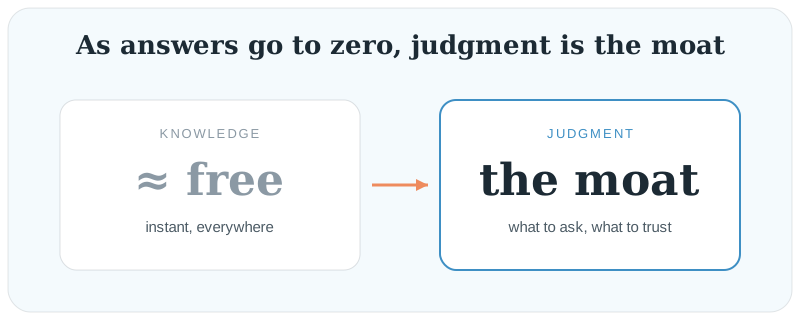
The price of an answer is going to zero
Ask a modern model a hard question and you get a competent answer in seconds. Not a perfect one, but often better than the median professional would give you on a busy afternoon. The marginal cost of a good answer is collapsing toward zero, and things that cost nothing do not stay moats.1
This is uncomfortable, because most of us were trained to be the person with the answer. That was the job. When the answer is free, the job changes.
What does not commoditize
Three things survive, and they are the things worth investing in now.
- Taste. Knowing which problem is worth solving, and which answer is good enough to ship. A model will happily give you a confident answer to the wrong question.
- Judgment. Knowing when to trust the output and when to distrust it. The cost of being wrong did not go to zero, even though the cost of an answer did.
- Responsibility. Someone still has to stand behind the decision. A model cannot be accountable. A person can.
The skill is no longer having the answer. It is knowing which answer to ask for, and whether the one you got is any good.
So what do you actually do
Stop competing on recall. Compete on judgment. The people and companies that win the next decade will be the ones who use cheap answers to ask better questions, and who keep a human firmly in the loop for the decisions that matter.2
That is the whole bet behind how we build at Virtropy. The tools are getting absurdly capable. The advantage is in the hands that point them at the right thing.
Key takeaways
- The cost of a good answer is collapsing toward zero, so recall stops being a competitive moat.
- Three things stay scarce: taste (which problem to solve), judgment (which answer to trust), and responsibility (who stands behind the decision).
- The move is to compete on judgment, not recall: use cheap answers to ask better questions, and keep a human in the loop for decisions that matter.
If you want to build that muscle in your team, that is exactly what the team training is for.
Citation
Please cite this work as:
Omar Miah. "AI commoditizes knowledge. Judgment is the moat.." Virtropy, June 22, 2026. https://virtropy.com/blog/ai-commoditizes-knowledge-judgment-is-the-moatBibTeX
@misc{omar2026,
  title  = {AI commoditizes knowledge. Judgment is the moat.},
  author = {Omar Miah},
  year   = {2026},
  note   = {Virtropy},
  url    = {https://virtropy.com/blog/ai-commoditizes-knowledge-judgment-is-the-moat}
}Building something that matters?
We embed with mission-driven teams to build their AI, data, and security capability. Everything starts with a short call.
Book a callMore on how we think? Read the writing.
AI's brand broke. That is the opening.
In eighteen months AI went from hopeful to scary, and from everyone's tool to the wealthy's portfolio. That erosion is not just a problem. It is the opening for a different kind of AI company.
ArticleSeven habits that make a team genuinely AI-fluent
AI will not take your job. Someone who understands AI will. Here are the seven habits that separate a team that is genuinely fluent from one that just has a chatbot tab open.
ResearchWhat actually works in AI team training, and what does not
After running and studying a stack of AI trainings, a clear pattern shows up: tool tours fade in a week, judgment sticks. Here is what the evidence says.