AI's brand broke. That is the opening.
AI has a brand problem, and it is bigger than most builders are willing to admit. The technology keeps getting more capable while the way people feel about it keeps getting worse. That gap is not noise. It is the most important thing happening in the category right now, and it is an opening.
The fall
In eighteen months, AI's brand fell about as far as any technology's has. It went from a hopeful, almost magical thing to something that reads as scary and elitist. The clearest tell: the only income group with a net positive view of AI is the one already doing well from it.1 If your portfolio is going up, AI looks like innovation. If your electricity bill is going up and you cannot invest in the companies driving it, it looks like something being done to you.
Why it broke
Two own goals. First, the loudest voices sell AI by catastrophizing it: the job apocalypse, the end of work, society reshaped overnight. That framing makes the technology sound seminal, which helps raise money at enormous valuations, but it also tells ordinary people the future is something to fear and that they had no say in it. Second, the visible benefits have flowed to the people who least need them. When the upside is a rising stock price and the downside is your job, the brand writes itself.
The opening
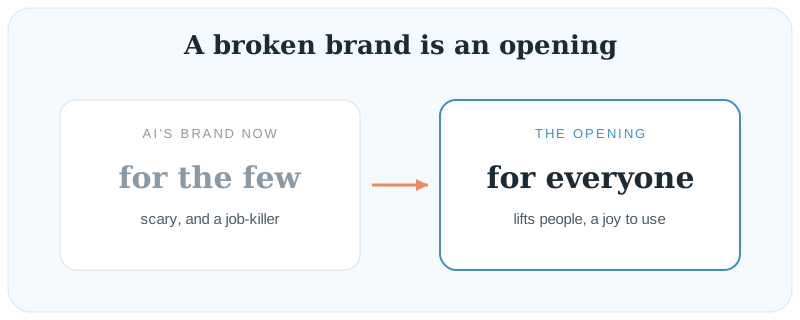
Here is the part most builders miss. A broken category brand is a gap in the market. When the leaders are read as scary and built for the few, there is open space for the opposite: AI that is made for everyone, that lifts people rather than replacing them, and that is a joy to use. That is not a softer position. It is a stronger one, because it is the version most people actually want and almost no one with a megaphone is offering.
What it looks like in practice
Human-centered AI is a set of choices, not a slogan. You build tools that make a person more capable and more present, not redundant. You teach people to use AI well instead of telling them it will replace them. You measure success by who you reached, not only by the valuation. And you keep a human in charge of the decisions that matter. None of this is charity. It is how you earn trust, and trust is the scarcest thing in AI right now.2
Key takeaways
- AI's brand eroded fast because it reads as scary and as a tool for the already-wealthy.
- A lot of the catastrophizing is marketing: a dramatic future helps justify dramatic valuations.
- A broken category brand is an opening for the opposite: AI that is for everyone, lifts people, and is a joy to use. That is the version most people want and few are building.
That opening is the whole reason Virtropy exists, and why we teach people and teams to use AI well rather than fear it. Start with the free live class, or see team training.
Citation
Please cite this work as:
Omar Miah. "AI's brand broke. That is the opening.." Virtropy, June 26, 2026. https://virtropy.com/blog/ais-brand-broke-the-openingBibTeX
@misc{omar2026,
  title  = {AI's brand broke. That is the opening.},
  author = {Omar Miah},
  year   = {2026},
  note   = {Virtropy},
  url    = {https://virtropy.com/blog/ais-brand-broke-the-opening}
}Building something that matters?
We embed with mission-driven teams to build their AI, data, and security capability. Everything starts with a short call.
Book a callMore on how we think? Read the writing.
AI commoditizes knowledge. Judgment is the moat.
When the answer to almost any question is free and instant, knowing things stops being rare. What stays rare is knowing which questions to ask, and what to do with the answers.
ArticleSeven habits that make a team genuinely AI-fluent
AI will not take your job. Someone who understands AI will. Here are the seven habits that separate a team that is genuinely fluent from one that just has a chatbot tab open.
ResearchWhat actually works in AI team training, and what does not
After running and studying a stack of AI trainings, a clear pattern shows up: tool tours fade in a week, judgment sticks. Here is what the evidence says.