AI is the computer of the nineties. Most people are about to make the same mistake.
In the early nineties, a personal computer sat on a lot of desks doing very little.1 Smart, capable people looked at it and reached one of a few conclusions: it was a toy, it was for the technical staff, or it was a fad that would pass. They were wrong in a way that quietly reshaped their careers.
We are standing at the same fork with AI, and the same three mistakes are on offer.
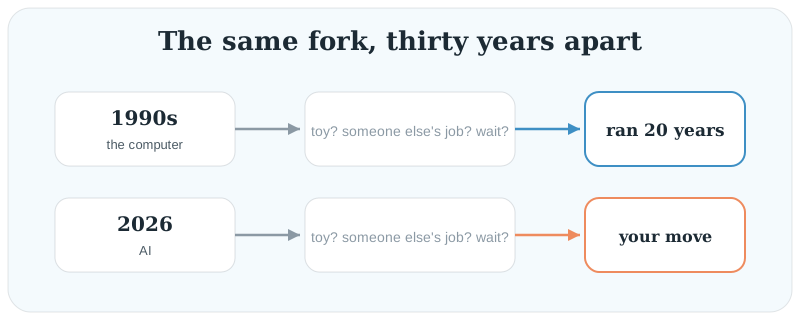
The toy mistake
"It makes things up, it cannot really reason, it is overhyped." This was said about the early web too. The honest version is that the tool is flawed and improving fast. Judging a fast-moving technology by its worst current output is how you get surprised by its best future output.
The someone-else's-job mistake
"That is for the engineers." In the nineties, the people who pushed the computer onto the IT department spent the next decade waiting on the IT department. The ones who learned the spreadsheet themselves moved faster than their whole org chart.
AI is heading the same way. It is becoming a general literacy, not a specialist tool.2 Outsourcing your fluency is outsourcing your leverage.
The wait-and-see mistake
"I will adopt it once it settles down." It is not going to settle down. There is no calm version coming where you can learn it once and be done. The skill is not memorizing a tool. It is staying fluent while the tool changes under you.
The people who won the computer era were not the ones who predicted it perfectly. They were the ones who got their hands dirty early and kept their hands dirty.
What the fork actually looks like
Here is the uncomfortable part. The fork does not feel like a fork. It feels like a normal Tuesday where you are slightly too busy to learn the new thing, so you do not. Multiply that Tuesday by two years and you get a person, or a company, that woke up behind.
The move is simple, even if it is not easy. Treat AI as a literacy. Use it on your real work. Build the judgment to know when it helps and when it lies. Do it now, while it still feels early, because early is the only time the advantage is cheap.3
Key takeaways
- AI in 2026 echoes the 1990s personal computer: the same three mistakes are dismissing it as a toy, treating it as someone else's job, and waiting for it to settle.
- It will not settle. The skill is staying fluent while the tool changes, not learning it once.
- The move is to treat AI as a literacy and practice it on your real work now, while the advantage is still cheap.
That conviction is why I teach a free live class every two weeks, and why we train teams to build this fluency before the gap gets expensive.
Citation
Please cite this work as:
Omar Miah. "AI is the computer of the nineties. Most people are about to make the same mistake.." Virtropy, June 1, 2026. https://virtropy.com/blog/ai-is-the-computer-of-the-ninetiesBibTeX
@misc{omar2026,
  title  = {AI is the computer of the nineties. Most people are about to make the same mistake.},
  author = {Omar Miah},
  year   = {2026},
  note   = {Virtropy},
  url    = {https://virtropy.com/blog/ai-is-the-computer-of-the-nineties}
}Building something that matters?
We embed with mission-driven teams to build their AI, data, and security capability. Everything starts with a short call.
Book a callMore on how we think? Read the writing.
AI's brand broke. That is the opening.
In eighteen months AI went from hopeful to scary, and from everyone's tool to the wealthy's portfolio. That erosion is not just a problem. It is the opening for a different kind of AI company.
ArticleSeven habits that make a team genuinely AI-fluent
AI will not take your job. Someone who understands AI will. Here are the seven habits that separate a team that is genuinely fluent from one that just has a chatbot tab open.
Op-edAI commoditizes knowledge. Judgment is the moat.
When the answer to almost any question is free and instant, knowing things stops being rare. What stays rare is knowing which questions to ask, and what to do with the answers.